
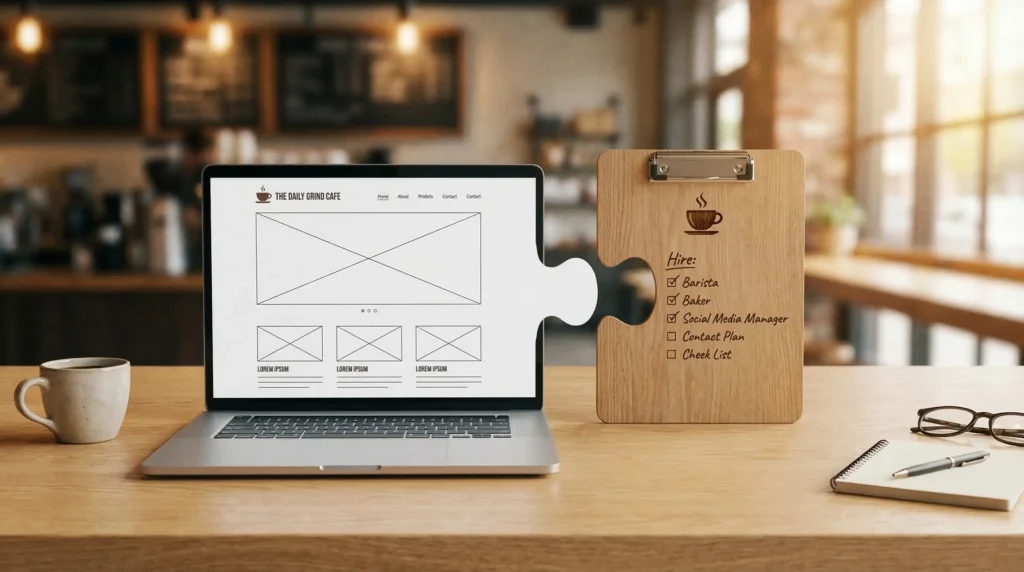
Choosing a website designer can feel like trying to find a needle in a digital haystack. You type “website designer for small business” into Google, and suddenly, your screen is a chaotic wall of noise.
Naturally, you start with the usual suspects:
- Fiverr
- Upwork
But as you scroll through hundreds of profiles, the same question keeps popping up: Who can I actually trust with my brand?
Most designers fall into the trap of building “digital brochures”, pretty pages that completely overlook your actual business needs and client expectations.
At NoorSoft Tech, we’ve spent years helping dozens of businesses shift their perspective. We transform websites from static, “too corporate” placeholders into high-performing growth engines.
This guide is designed to help you find a partner who does more than just give your site a visual makeover; you need a partner who actually makes your phone ring.
How to Choose a Web Designer and Developer for a Small Business
To choose the right designer, you must ensure they possess a deep, intuitive understanding of your business.
It isn’t just about a pretty layout; it’s about
- brand recognition,
- specific color schemes,
- and the psychological patterns your industry requires.
that your audience expects.
A truly strategic partner focuses on conversion-driven design. They don’t just build a site; they curate a user experience that keeps visitors engaged and gently nudges them toward taking action.
Unfortunately, this is where most designers fail. They lean on generic, “one-size-fits-all” templates that ignore your brand identity and lack the custom functionality your business needs to actually scale.
Why Most Small Businesses Choose the Wrong Web Designer
Most businesses fall behind because they hire for aesthetics rather than alignment. They choose a designer based on a “pretty” portfolio that looks great on the surface but completely misses the mark on their mission statement.
Think of it like buying a suit off the rack: it might look fine from a distance, but it doesn’t fit your frame, your voice, or your professional standards.
When a designer ignores your unique brand DNA, they create a “digital disconnect.” Your customers feel it instantly. They don’t just browse; they hit the back button opening a competitor’s tab before your page even finishes loading. They don’t convert because they don’t feel a connection.
A true partner flips this script. They focus on designing an experience that bridges that gap, guiding visitors from “just looking” to “ready to buy.”
The 5-Level Framework for Evaluating a Web Designer or Developer
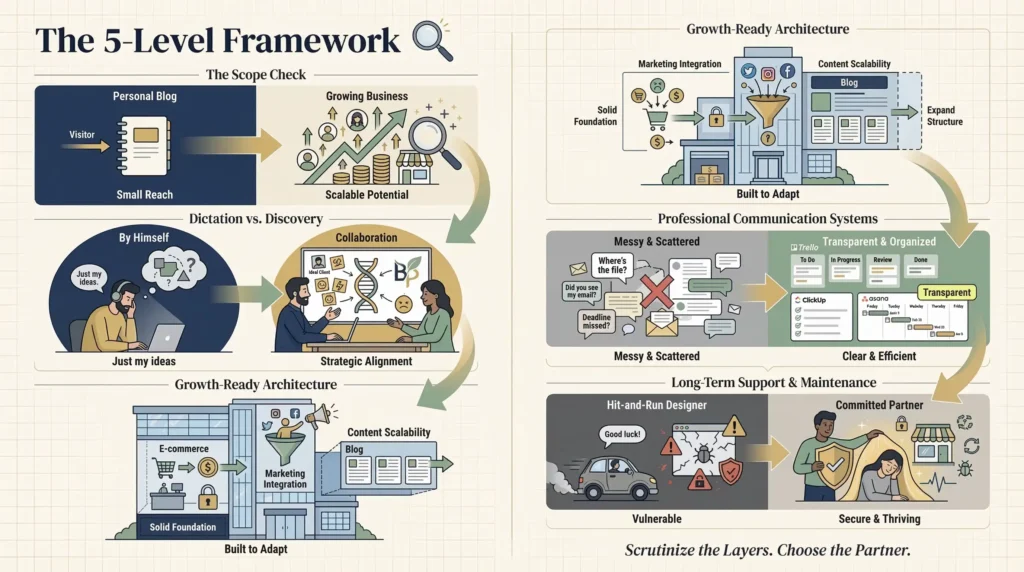
Before you sign a contract, put your potential partner through these five layers of scrutiny.
1. The “Scope” Check
Don’t just look at screenshots. Ask: “How many businesses like mine have you actually grown?” If a designer has only built personal blogs, they won’t grasp the lead-generation needs of a scaling business. You need a partner with a proven track record of moving the needle.
2. Dictation vs. Discovery
Pay close attention to how the project begins:
- The “By Himself” Designer: Listens for two minutes, says “I got it,” and disappears for a month. They are building what they think is cool, not what you actually need.
- The Strategist: Digs into your ideal customer, your pain points, and your revenue goals. They don’t draw a single line until they understand your brand DNA.
3. Growth-Ready Architecture
A strategist ensures your site isn’t a dead end. They build with the future in mind, ensuring your infrastructure can handle:
- Seamless E-commerce: Can customers pay you without jumping through hoops?
- Marketing Integration: Can you track influencer traffic or sync with social shops?
- Content Scalability: Can you add a blog or a new service page without paying a developer every time?
4. Professional Communication Systems
Professionalism in communication usually mirrors professionalism in the code. If a designer relies on scattered WhatsApp messages or buried email threads, critical details will get lost. A true professional uses organized platforms like Trello, ClickUp, or Asana to keep files, deadlines, and feedback in one transparent place.
5. Long-Term Support & Maintenance
The relationship shouldn’t end the moment the site goes live. A “hit-and-run” designer leaves you vulnerable to hackers and broken links. You need a partner who provides ongoing maintenance and someone to handle security updates and technical “tune-ups” so your site stays fast and secure while you sleep.
Service Provider Comparison Matrix
Choosing the right partner depends on your budget, the complexity of your project, and whether you need a simple template or a custom-engineered growth tool.
| Feature | Freelancer | Boutique Agency (Recommended) | Full-Service Agency |
| Cost Range | $1,500 – $5,000 | $5,000 – $20,000 | $25,000+ |
| Technical Depth | Variable; often narrow | High; specialized roles | Very High; multi-departmental |
| SEO Capability | Basic/Intermediate | Strategic & Integrated | Advanced/Enterprise |
| Scalability | Low | High | Unlimited |
| Risk Level | High (Single point of failure) | Low (Balanced/Redundant) | Moderate (High overhead/Cost) |
| Best For | Tight budgets/Simple sites | Growth-focused small businesses | Enterprise/Large Corporations |
The Bottom Line
A freelancer might seem like the budget-friendly choice upfront, but you’ll eventually pay in time and stress. You’ll find yourself playing project manager juggling a designer, a developer, and an SEO specialist who aren’t even talking to each other.
At Noorsoft Tech, we manage the entire digital ecosystem under one roof. You get a single, dedicated point of contact and a team that works in total sync. We do the heavy lifting; you run your business.
The Technical “Solid Foundation” Checklist
You don’t need to be a technical genius, but your developer certainly does. If they can’t explain these four pillars in plain English, it’s a red flag. Here is what your site must have to survive in today’s market:
- Mobile-First: The majority of your customers will find you on a smartphone. Your site must be engineered for thumbs, not just mice. If it’s clunky on a screen the size of a palm, you’ve already lost the lead.
- The 3-Second Rule: Speed is a currency. If your site takes longer than three seconds to load, 53% of your visitors will bounce. Your developer must know how to keep the architecture “snappy” and lightweight.
- Search Engine Readiness: A pretty site is useless if it’s invisible. Your developer needs to implement Schema Markup, the “hidden code” that tells Google exactly who you are, what you do, and where you are located.
- The Security Shield: Without an SSL certificate (that essential padlock icon) and a rigorous backup plan, you are a sitting duck for hackers. Security isn’t an “add-on”; it’s a requirement.
Designing for Your Ideal Customer
At Noorsoft Tech, we have a counter-intuitive rule:
We don’t build for you. We build for the person who is going to give you money.
A high-converting website isn’t an art gallery; it’s a psychological journey. To turn a stranger into a lead, your page must follow a clear, friction-free path:
- The 2-Second Hook: You must answer “What do you do?” before the user even finishes their first blink.
- The Trust Factor: We integrate “Social Proof” real-world testimonials and 5-star badges.
Remember: People trust their neighbors, not your ads.
- The Scannable Solution: We use punchy bullet points to highlight your value. In the digital age, people scan; they don’t read.
- The Friction-Killer: A massive, unavoidable “Call Now” or “Get a Quote” button. If a customer has to “find” how to pay you, you’ve already lost them.
The “SEO-First” Validation Framework
A common (and expensive) mistake is treating SEO as a “later” problem. High-performance SEO must be baked into the DNA of your website from day one. Without it, you’ll end up with a beautiful digital billboard sitting on page 10 of Google where no one will ever find it.
To truly move the needle for your business, your site must be:
- Google Search Ready: This isn’t just about keywords. Every page must be architected so Google’s “crawlers” know exactly what services you offer and precisely where you are located.
- Google Ads Optimized: If you ever run paid traffic, a “messy” site will literally cost you more money. Google rewards high-quality, relevant pages with lower costs-per-click. A well-built site pays for itself in ad savings alone.
- Conversion-Focused Landing Pages: You don’t just need a homepage; you need a “Service-Specific” strategy. If a customer searches for “Emergency Leak Repair,” they shouldn’t land on a generic “About Us” page. They need a dedicated page that solves their specific problem instantly increasing the chance they call you.
- Local Map Mastery: For small businesses, the “Map Pack” is your lifeblood. Your site needs Schema Markup the specific “hidden code” that proves to Google: “This is a verified, local business at this exact physical address.”
Platform Selection Matrix: WordPress vs. The Rest
| Platform | Best For | Pros | Cons |
| WordPress | Most Small Businesses | Absolute SEO control, massive ecosystem, ownership. | Requires active maintenance and security updates. |
| Shopify | E-commerce | Best-in-class checkout, easy scaling, hosted security. | Monthly app fees can climb; less flexible for SEO content. |
| Squarespace | Portfolios/Simple Services | Beautiful templates, all-in-one hosting, easy for DIY. | Limited technical SEO and deep customization. |
| Custom Code | High-Traffic/Unique UX | Maximum speed, zero bloat, total uniqueness. | Expensive to build and maintain. |
Ownership: Don’t Become a “Digital Hostage”
I’ve seen heart-breaking cases where business owners lose their entire digital history, years of work and SEO ranking simply because a freelancer disappeared or held their credentials for ransom.
At Noorsoft Tech, we believe in total transparency. You should never be “locked” into a relationship; you should stay because of the results. To protect your investment, we ensure three things:
You Own the Domain: Your web address is your digital real estate. It must be registered in your name, under your account. Period.
Full “Master” Access: You receive the Master Login credentials from day one. You are the owner; we are the architects.
Global Industry Standards: We build on open, world-class platforms like WordPress or Shopify. Why? Because if you ever decide to move on, any professional developer in the world can step in and take over. You aren’t trapped in a “secret” proprietary system that only one person understands.
Pricing Psychology: What Should a Small Business Pay?
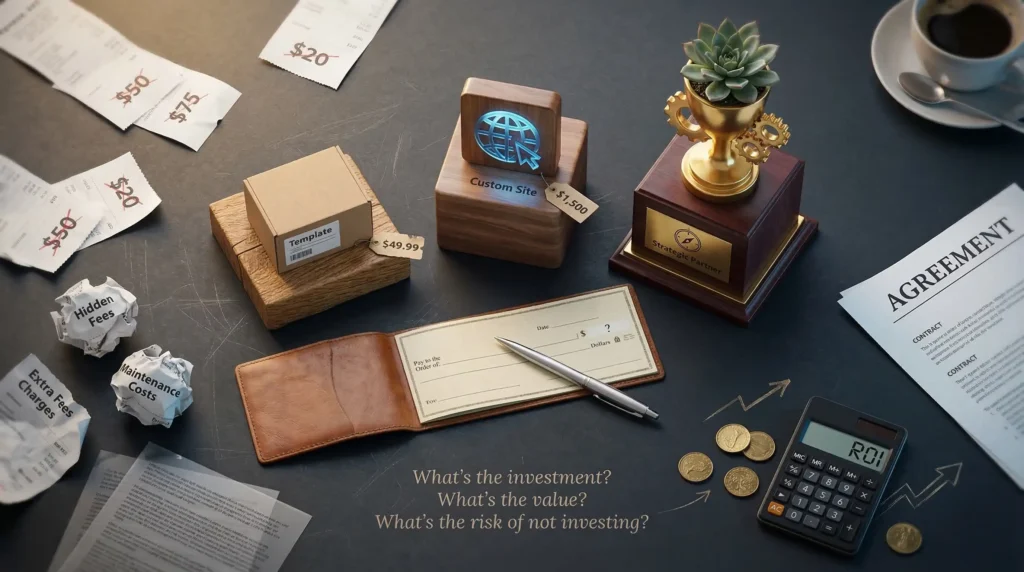
In the digital world, you generally get what you pay for. While a $500 website might look like a bargain, it’s often an expensive mistake when it fails to generate a single lead. To help you budget, here is how the market breaks down:
- The Budget Tier ($1,500 – $4,000): Usually a basic template with minimal customization. This is a fine “starter” option for a brand-new business, but don’t expect it to do much “heavy lifting” when it comes to sales or SEO.
- The Growth Tier ($5,000 – $15,000): The “Sweet Spot” for established businesses. You aren’t just paying for a site; you are paying for strategy, professional copywriting, and a conversion engine designed to turn strangers into customers.
- The Enterprise Tier ($20,000+): For complex businesses requiring deep custom software, massive e-commerce catalogs, or specialized integrations.
The Agency Advantage
An agency can feel like a larger upfront investment, but it is almost always more cost-effective in the long run. Instead of wasting your time finding and managing a separate designer, developer, and SEO expert, you get a unified team working under one roof.
The Noorsoft Tech Specialization
We focus exclusively on the Growth Tier for U.S. small businesses. We provide the high-end strategy of a large firm, but with the personal, one-on-one attention your business deserves. We don’t just build websites; we build assets.
5 Questions That Reveal True Expertise
Before you sign a contract, put your potential partner on the hot seat. Their answers will tell you instantly if they are a “template-pusher” or a true growth partner:
- “Can you show me a site where you successfully balanced brand identity with a high conversion rate?”
- What to look for: They should be able to explain how the design didn’t just look pretty, but actually drove specific user actions.
- “How do you ensure the site architecture is ready for Google Ads or SEO scaling later?”
- What to look for: A pro will mention landing page structure, fast load times, and clean metadata not just “I’ll add a plugin.”
- “What project management system do you use to keep me in the loop?”
- What to look for: Professional names like ClickUp, Trello, or Asana. If they say “just email me,” expect things to get lost.
- “When the site is finished, will I have 100% ownership and the freedom to move it if I choose?”
- What to look for: A firm “Yes.” Any hesitation here suggests they might try to keep you as a “digital hostage.”
- “What does your post-launch support look like?”
- What to look for: A clear plan for security updates, speed optimization, and technical “tune-ups.” You aren’t looking for a one-time vendor; you’re looking for a long-term partner.
FAQs
How much should a small business pay for a website?
For a professional, SEO-optimized website in the U.S., expect to invest between $5,000 and $15,000. While cheaper options exist, they often lack the conversion strategy and technical performance required to generate a positive return on investment (ROI).
Is WordPress better than Squarespace?
WordPress is superior for businesses prioritizing SEO, scalability, and long-term ownership. Squarespace is an excellent entry-level choice for businesses that need a simple, aesthetic presence without the need for advanced technical customization or deep search engine dominance.
How long does it take to build a website?
A standard, high-quality small business website typically takes 8 to 12 weeks. This includes phases for discovery, wireframing, design, development, and rigorous QA testing. Rushed projects often result in poor technical SEO and missed conversion opportunities.
Should I hire local or remote?
Hiring locals is beneficial for face-to-face strategy and regional market knowledge. However, technical competency is more important than geography. A remote developer with a proven track record in your industry is often a better investment than a local generalist.
What should be included in a web design contract?
A robust contract must include a detailed scope of work, a timeline with milestones, payment schedules, a clear definition of ownership (you should own everything), and a post-launch support or warranty period for fixing bugs.
Can I update my website myself?
Yes, if your developer uses a modern CMS like WordPress or Shopify. Your contract should include a “training session” where the developer teaches your team how to update text, swap images, and add blog posts without breaking the site’s code.
Executive Summary: The Web Designer Checklist
If you remember nothing else, keep these six pillars in mind when vetting your next digital partner:
- Strategy Over Aesthetics: Choose a partner who asks about your revenue goals and SEO, not just your favorite colors and fonts. A pretty site that doesn’t sell is a failed investment.
- Verify Real-World Performance: Don’t take their word for it. Run their portfolio through Google PageSpeed Insights. If their previous work is slow, your new site will be too.
- Demand Total Ownership: Upon final payment, you must own the domain, the hosting account, and every line of code. Never let a designer hold your digital assets hostage.
- Technical Depth is Mandatory: Confirm they are building for the future. Ask about Core Web Vitals, Schema Markup, and Mobile-First indexing. These are the requirements for ranking on Google today.
- Built for Scalability: Ensure your site is built on a flexible platform like WordPress. You need a system that can grow with your business over the next decade, not one you’ll outgrow in six months.
- The Post-Launch Lifeline: A website is a living thing. Never hire a developer who doesn’t provide a clear, proactive plan for security updates, backups, and technical maintenance.
Conclusion: Your Website is Your Most Important Salesperson

Think of your website as the only employee you have who works 24/7, never takes a sick day, and delivers the same perfect pitch to every visitor.
You shouldn’t settle for a static “digital brochure” that just sits there. You deserve a growth engine, a high-performance asset that reflects your brand’s excellence and actually makes your phone ring.
At Noorsoft Tech, we’ve spent 12 years helping small businesses ditch the cookie-cutter templates and start winning. We don’t just build websites; we build the future of your business.
Ready to stop guessing?
Would you like us to conduct a Free “Strategy Audit” of your current site? We’ll identify exactly where you might be losing customers and show you how to turn your site into a lead-generating machine.