
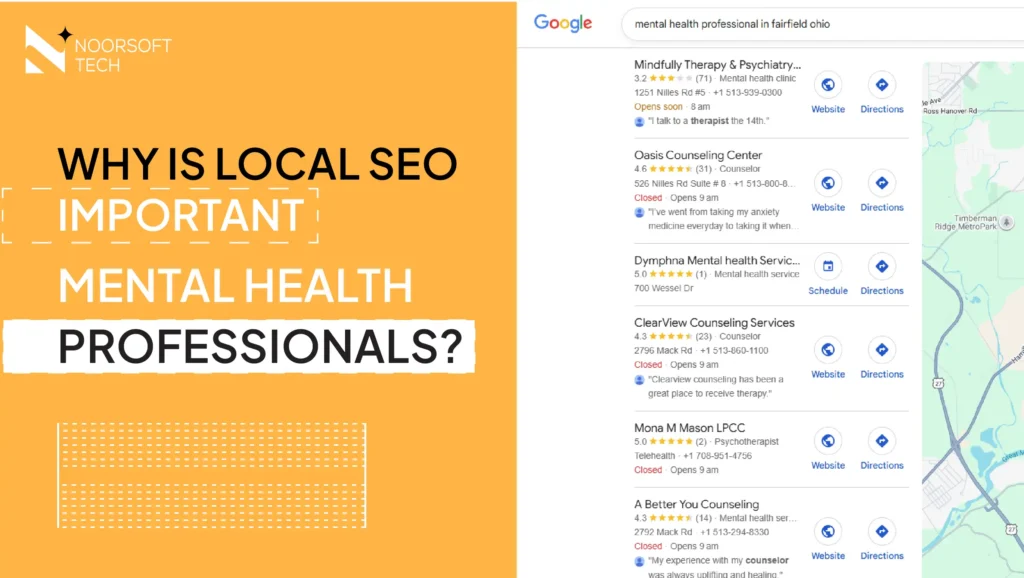
In 2026, the landscape of patient acquisition has shifted fundamentally. If you are a clinic owner or a decision-maker at a mental health practice, you have likely heard the whispers: “Is SEO still relevant in the age of AI?” Or perhaps, “Shouldn’t we just put everything into social media and paid ads?“
The reality is that local SEO has not become obsolete; it has evolved into the single most important asset for mental health practice growth. In 2026, search is no longer just about blue links on a Google results page. It is an interconnected ecosystem of Google Maps, AI Overviews, Large Language Models (LLMs) like ChatGPT, and voice-activated search interfaces.
For therapists, psychologists, and psychiatric clinics, local SEO is the bridge between a person in crisis and the professional help they need. This guide will explore why local SEO is the core of a high-growth mental health practice in 2026 and how it powers visibility across the entire digital search landscape.
Local SEO in 2026 Is Bigger Than Traditional Google Rankings
For years, SEO was defined by ranking number one for a specific keyword. While ranking is still important, the geometry of the search engine results page (SERP) has changed.
Today, when a prospective client searches for “anxiety therapist near me” or “couples counseling in Austin,” they are not just looking at a list of websites. They are interacting with a multifaceted interface.
In 2026, local SEO encompasses:
- The Google Map Pack: The three-listing highlight that dominates mobile and desktop screens.
- AI Overviews: AI-generated summaries that synthesize information from top-rated local practices to answer user queries instantly.
- Review Aggregation: Direct comparisons of clinical reputation based on patient feedback.
- Local Business Comparisons: AI-driven tables comparing services, insurance accepted, and availability.
- The Organic Listings: Traditional website links that now serve as the citations and proof for the AI’s answers.
If your practice is not optimized for local search, you are not just missing out on a website click; you are invisible to the AI assistants and mapping tools that clients use to navigate their healing journey.
AI Search Platforms Still Depend on SEO Signals
There is a common misconception that AI search engines like ChatGPT, Perplexity, and Bing Copilot operate independently of SEO. This is false.
These platforms do not think on their own; they summarize the most authoritative, accessible, and well-structured data available on the web. To be recommended by an AI as a “top-rated psychologist in Austin,” your digital footprint must provide the necessary signals.
AI answer engines rely on:
- Structured Data (Schema Markup): Code that tells search engines exactly what your services are, your location, and your credentials.
- Citations and Consistency: Ensuring your Name, Address, and Phone Number (NAP) are identical across the web.
- Website Authority: High-quality content that demonstrates clinical expertise.
- Review Sentiment: AI analyzes the tone and content of your reviews to determine if you are a compassionate or specialized provider.
In short, if your clinic is not optimized for search engines, it likely will not appear in AI-generated recommendations either. SEO is the fuel that powers AI visibility.
Mental Health Is One of the Highest-Intent Local Search Verticals
In marketing, we talk about search intent. In the mental health vertical, this intent is exceptionally high. Unlike someone browsing for a new pair of shoes, a person searching for “trauma therapy” or “depression treatment” is often experiencing significant emotional urgency.
These are bottom-funnel searchers. They are not looking for general information; they are looking for a provider to book an appointment with right now.
Because the intent is so high, the conversion rate for local search traffic in the mental health space far exceeds that of social media or cold outreach. When a user finds you through a local search, the booking is already halfway complete because they initiated the search with a specific need.
Real-World Example: Scaling Mental Health Practices via SEO
To understand how these strategies manifest in actual practice growth, let us look at two distinct case studies where specialized local SEO replaced the need for massive advertising budgets.
Case Study 1: Therapy Austin
twoWhen we began working with Therapy Austin, the practice was seeing approximately 600 clicks per month. By implementing a rigorous local SEO framework, we grew that traffic to 1.8K clicks per month, a 200 percent increase in organic discovery.
Our primary strategy was built on three pillars:
- GBP Multi-Location Optimization: We optimized the Google Business Profiles for four distinct locations, ensuring each had localized content and high-quality images.
- The City-Modifier Strategy: We created dedicated service pages for each GBP location. Furthermore, we developed individual service pages for every therapeutic modality (e.g., CBT, EMDR) using city modifiers (e.g., “CBT Therapy Austin”). This allowed us to capture specific, high-intent local searches.
- Internal Linking vs. Backlinks: Because we did not have a large budget for external backlinking, we focused on building authority from within. We created a library of relevant, user-focused blogs. Through these blogs, we implemented a sophisticated internal linking structure that funneled authority to our city-specific service pages.
The result? Our primary “Couples Therapy Austin” service page, which started at position 27, now ranks at number two and other keywords like “teen therapy” and “family therapy” are also in top 3.. This growth was achieved entirely through SEO, proving that serving the user’s interest through content and structure can overcome budget constraints in competitive markets.
Case Study 2: Mindfully
Mindfully, a mental health clinic in Ohio, presented a different challenge: multiple business units across various regions. For this organization, the goal was to scale local presence without losing the “small-practice” feel that patients trust.
Our strategy included:
- Business Unit Location Pages: We created custom location pages for every single business unit, ensuring each reflected the unique staff and services of that specific office.
- Content Support at Scale: To support these location pages, we produced over 100 high-quality blogs.
- Targeting Local Intent: Each blog was written to target local intent search queries. We did not just write about mental health in general; we wrote about mental health issues affecting their specific communities.
- Ranking through Relevance: By doing heavy internal linking through these 100+ blogs, we successfully ranked the service pages for each business unit. This localized intent search strategy ensured that each clinic was the top choice in its respective area.
Why SEO Reduces Dependence on Paid Ads and Referrals
While referrals are the lifeblood of many solo practices, they are inherently unpredictable. You cannot turn up referrals when you hire a new clinician or open a new office.
Paid ads, on the other hand, are predictable but expensive. In the mental health space, “Cost Per Click” for competitive terms continues to rise.
SEO offers the middle ground: Predictability without the perpetual tax.
A mature SEO strategy creates a flywheel effect. As you rank better, you get more clicks. As you get more clicks and reviews, your authority increases. As your authority increases, AI platforms recommend you more often. Eventually, the organic lead flow becomes so robust that paid advertising becomes an optional boost rather than a survival necessity.
Also read our blog on: How to Respond to Google Reviews
What Makes Local SEO Different for Mental Health Professionals?
You cannot approach SEO for a therapy clinic the same way you would for a plumber. The mental health vertical has unique nuances:
- Trust and Reputation (YMYL): Google classifies mental health as “Your Money, Your Life” content. This means the bar for expertise, authoritativeness, and trustworthiness (E-E-A-T) is much higher. Your content must be clinically sound and professionally presented.
- Privacy and Ethics: Review generation must be handled with extreme care, ensuring compliance with ethical guidelines regarding patient solicitation.
- Specialization Pages: People do not just search for “therapy.” They search for “EMDR for PTSD,” “LGBTQ+ affirming counseling,” or “child ADHD assessments.” Your SEO must be granular.
- Telehealth vs. Local Presence: In 2026, your SEO must balance ranking for your physical neighborhood while also capturing state-wide telehealth searches.
Core Components of Effective Local SEO for Therapists in 2026
If you want to win the local search game, your strategy must include these core pillars:
- Google Business Profile Optimization: Daily or weekly management of reviews, posts, and service updates.
- Local Landing Pages: Dedicated, high-converting pages for every suburb or city you serve.
- Service-Specific SEO: Deep-dive pages for every modality (CBT, DBT) and condition (Anxiety, Depression) you treat.
- Internal Linking Strategy: As seen in the Therapy Austin case study, using blogs to build the authority of your service pages is critical when backlinking budgets are tight.
- Entity Optimization: Using Schema markup to help AI search engines understand the entity of your practice, linking your clinicians, their credentials, and their locations together.
- Technical SEO: Ensuring your site is lightning-fast and mobile-first, as most mental health searches happen on smartphones.
The Practices Winning in 2026 Treat SEO as Omnichannel Search Optimization
The most successful mental health clinics have stopped viewing SEO as a website task. They view it as Digital Visibility Optimization.
They understand that when a potential client asks their phone, “Find a therapist near me that takes Blue Cross Blue Shield,” the answer they receive is determined by a complex web of SEO signals.
Winning in 2026 means being visible:
- In the Map Pack when they want proximity.
- In the AI Overview when they want a summary of the best options.
- In the Organic Results when they want to verify your expertise.
- In ChatGPT when they are looking for a personalized recommendation.
The Path Forward
In 2026, local SEO will be the most powerful tool in a mental health professional’s marketing arsenal. It is the only channel that combines high-intent lead generation with long-term, compounding ROI. While the technology (AI, LLMs, and voice search) continues to change, the underlying signals that drive visibility remain rooted in high-quality SEO.
Whether you are a single location like Therapy Austin looking to triple your traffic, or a multi-unit organization like Mindfully looking to dominate local intent, SEO is the engine of growth. By investing in a specialized, omnichannel search strategy, you are not just ranking a website; you are ensuring that when someone in your community reaches out for help, your practice is the one they find.Ready to grow your practice with a strategic SEO approach?
Don’t leave your visibility to chance. Invest in a specialized therapist SEO strategy that powers your growth across Google, AI, and beyond.